A homeowner in Norwalk notices water stains on the ceiling after heavy rain. They search Google for a roofing contractor, open several websites, and start comparing their options.
One website takes too long to load. Another looks outdated and makes it difficult to find a phone number. A third displays photos of completed projects, clearly explains its roofing services, and makes it easy to request an inspection.
Which company is more likely to receive that homeowner's inquiry?
For construction, roofing, plumbing, HVAC, and home-improvement businesses across Connecticut, a website often serves as the first serious introduction to a potential customer.
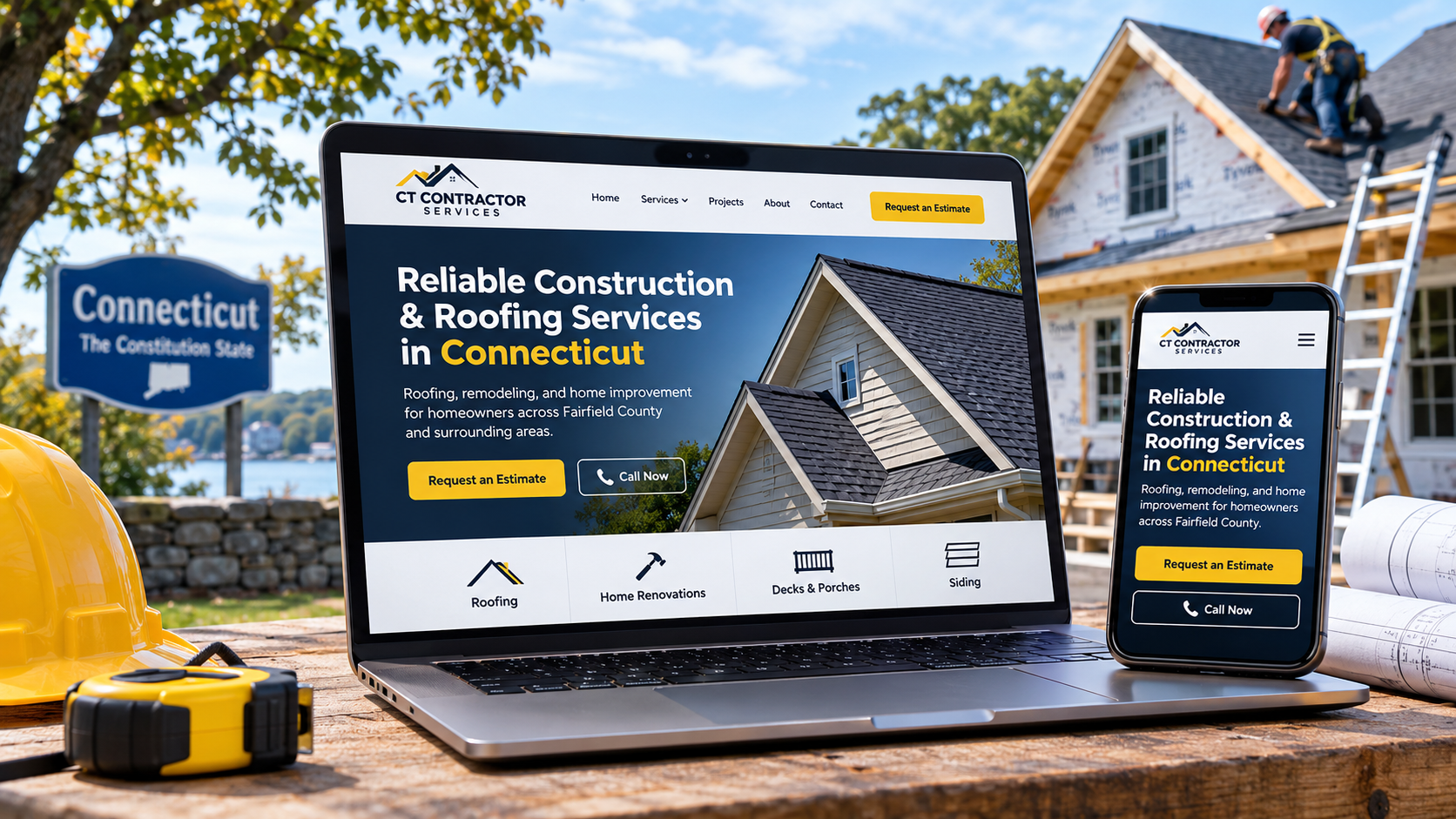
Effective website design for contractors in Connecticut combines mobile-friendly pages, clear service descriptions, credible project evidence, local SEO, and simple contact options.
The goal is not simply to create an attractive website. It is to help nearby homeowners understand your services, trust your company, and contact you when they need work completed.
Whether your contracting business operates in Stamford, Norwalk, Bridgeport, New Haven, Hartford, or surrounding communities, these nine improvements can make your website more useful to potential customers.
1. Make Your Website Immediately Explain What You Do and Where You Work
Many contractor websites make visitors search for basic information.
The homepage might say something generic, such as "Quality You Can Trust," without clearly explaining the services offered or the company's geographic coverage.
A homeowner looking for roof repairs should not have to read several paragraphs to determine whether your business can help.
Your homepage should immediately communicate three things: your primary service, the location you serve, and how to request assistance.
For example, a roofing contractor serving Fairfield County could use a heading such as:
Roof Repair and Replacement Services in Norwalk, CT
A supporting sentence could explain:
"Residential roofing repairs, roof replacement, and leak inspections for homeowners in Norwalk and surrounding Fairfield County communities."
This approach uses location terminology naturally while answering the customer's immediate questions.
It also helps search engines understand the subject of the page.
Avoid listing every Connecticut town in your main heading. Focus on the company's actual services and primary market.
2. Build Mobile-Friendly Websites for Connecticut Homeowners
A significant part of the contractor customer journey can happen on a smartphone.
Someone dealing with a leaking roof, broken heating system, or plumbing problem may not be sitting at a desktop computer.
Your mobile website should make contacting your business straightforward.
Important features include a readable layout, appropriately sized buttons, clearly visible navigation, and phone numbers that visitors can tap to call.
A roofing company's mobile homepage, for example, could feature two prominent actions:
Call for Roofing Assistance and Request a Free Estimate, if the company actually offers free estimates.
These actions should lead somewhere useful rather than appearing as decorative buttons.
A phone button should start a call. An estimate button should open a working form.
Also pay attention to page speed.
Google's Core Web Vitals measure aspects of loading, responsiveness, and visual stability. For websites, improving these measures can create a better experience for customers trying to use the site quickly.
You can evaluate individual pages with Google PageSpeed Insights.
However, a high performance score alone does not guarantee leads or strong search rankings. The website must still provide useful content and clear contact paths.
3. Create Dedicated Pages for Your Most Important Services
One common weakness of small contractor websites is placing every service on the homepage.
A construction company might offer roofing, siding, gutters, decks, and general renovations but explain all five in a single paragraph.
That makes it harder for potential customers to learn about individual services.
It also limits your opportunity to provide detailed information relevant to specific searches.
Instead, create a dedicated page for each meaningful service.
For a roofing contractor, the website structure could include:
Roof Repair
Roof Replacement
Emergency Roof Leak Repair
Skylight Repair and Replacement
Gutter Installation and Repair
Each service page should explain the problems addressed, available solutions, the company's process, and what customers should expect when requesting an estimate.
For example, a roof repair page could discuss missing shingles, damaged flashing, water infiltration, and common reasons for requesting a professional roof inspection.
It should also include relevant images and a clear contact option.
A separate page is useful when it answers a genuinely different customer need—not simply because it creates another opportunity to insert keywords.
A plumbing company in New Haven might apply the same structure to drain cleaning, water heater repairs, pipe leaks, and fixture installations.
4. Use Local SEO to Reach Customers in Your Actual Service Area
Local SEO helps businesses communicate geographic relevance to people searching for nearby services.
For Connecticut contractors, this means describing the places they genuinely work rather than adding city names randomly.
Consider a home-improvement company based in Stamford that also serves Greenwich, Darien, and New Canaan.
Its website can mention these communities where relevant, especially when discussing service availability or documenting real projects.
However, creating dozens of nearly identical pages that simply change the city name is not a sustainable SEO strategy.
Instead, create a useful primary service-area page and expand into individual location pages only when there is enough distinct information to justify them.
A strong location page might include actual project examples, specific services available there, customer questions, and useful local details.
Google Business Profile also matters
For contractors who visit customers at their properties, an accurate Google Business Profile can be an important part of local search visibility.
Google identifies three major local ranking factors: relevance, distance, and prominence. There is no paid shortcut that guarantees a better local ranking.
Keep business information accurate, select appropriate categories, maintain current contact details, and encourage genuine customer reviews without incentives that violate Google's policies.
Service-area businesses should represent their actual location and geographic coverage correctly. Contractors who do not serve customers at their business address should generally hide that address from public display.
For businesses operating around Norwalk or Bridgeport, the objective is to show relevant services to people who can actually hire them.
Not every search visitor is a suitable customer. Geographic accuracy helps reduce irrelevant inquiries.
5. Show Real Construction, Roofing, and Plumbing Projects
Before hiring a contractor, homeowners often want evidence that the company has completed similar work.
Professional photography can help establish credibility, particularly for services involving significant financial commitments.
A roofing company could show images of completed asphalt shingle roof replacements, flashing repairs, or skylight installations.
A deck contractor could document an older deck before restoration and the finished project after repairs.
A plumbing company could explain a water heater replacement, including the problem identified and the solution provided.
Avoid filling project pages with generic stock photographs when real work is available to show.
A useful project section should include the type of work, general location, relevant challenges, and the completed result.
An example from my web development portfolio
One project featured on my website is Golden Hands Construction — Roofing Website, built for a roofing business serving homeowners across Long Island, New York.
The project emphasizes clear service information, local project photography, responsive design, and prominent contact options.
Although Golden Hands serves a different geographic market, the same website-design principles are applicable to contractors in Connecticut.
You can explore this work through my web development portfolio.
The lesson is straightforward: instead of relying entirely on claims about quality, a contractor website should help customers see the services provided and understand how to request similar work.
6. Make Requesting an Estimate Easy
A contractor website should give visitors a clear next step.
If someone is considering a roof replacement in Fairfield County, they should not need to search through several pages to find a contact form.
Place relevant contact options on your homepage, service pages, and contact page.
An estimate form might request the customer's name, email, phone number, service needed, property location, and a short description of the project.
If photographs would help with the initial assessment, consider an optional photo-upload field.
Keep the form simple. Asking for unnecessary information can create friction.
Also make sure submissions reach the intended inbox.
A technically functioning website with a broken contact form can quietly lose opportunities.
For businesses receiving inquiries through several channels, a CRM integration can help organize incoming requests and track follow-ups.
Before launching a new website, complete a real test submission and confirm that the notification arrives correctly.
7. Improve Trust With Clear Business Information
Trust is especially important when customers are hiring someone to work on their home.
A website with vague contact information, missing company details, or unverified claims may create uncertainty.
Include a clear company name, legitimate contact methods, realistic service descriptions, and an About page explaining the business.
Where applicable, provide accurate licensing and insurance information.
Contractors should verify which credentials apply to their specific services and ensure that any displayed claims are current.
Client testimonials can also help, provided they are authentic and used with appropriate permission.
Do not create fabricated reviews or misleading star ratings.
If your business has genuine customer feedback, display it in context and avoid implying that every review has been independently verified when it has not.
A professional website should communicate the same level of reliability that you expect customers to experience during the actual project.
8. Measure Which Pages Generate Real Customer Inquiries
Website traffic is useful, but traffic alone does not tell a contractor whether the website is producing business opportunities.
A roofing company might receive hundreds of visits from people researching roofing materials, while a smaller number of visitors are ready to request an inspection.
Those visitors have different intentions.
This is why tracking inquiries matters.
Google Analytics 4 can help measure selected website interactions, while Google Search Console provides information about Google Search visibility and search queries.
Useful actions to measure include successful estimate-form submissions, phone-button clicks, and booking requests.
However, a phone-button click is not necessarily a completed phone call, and a form submission is not automatically a qualified lead.
Keep these distinctions clear in reporting.
For example, if a roof replacement page receives regular visits but very few inquiries, examine its content and contact options.
Does it clearly explain the service? Are completed project examples visible? Does the page provide enough information for visitors to decide whether to contact the company?
Improving those elements may be more valuable than simply publishing additional blog posts.
9. Maintain Your Website After Launch
A new website is not a permanent fix if it receives no ongoing attention.
Contractor businesses change over time. Services expand, project portfolios grow, contact details change, and software requires maintenance.
Your website should reflect those developments.
For WordPress websites, regular maintenance can include reviewing updates, checking backups, monitoring forms, testing mobile layouts, reviewing technical SEO, and identifying performance issues.
Maintenance should also include content accuracy.
If a plumbing company no longer offers a particular service, its website should not continue advertising that service.
If a roofing contractor completes a significant project, consider adding a useful case study with permission and appropriate images.
This creates fresh information that genuinely helps future customers.
A consistent maintenance process reduces the risk that overlooked problems will interfere with inquiries.
How Much Does a Contractor Website Cost in Connecticut?
Website costs depend on the project scope rather than just the number of pages.
A small business that needs a five-page informational website has different requirements from a construction company needing multiple service sections, project galleries, online booking, and advanced analytics.
Common factors affecting cost include custom design, content preparation, required integrations, website migration, search optimization, and long-term maintenance.
A simple template-based site may require less development than a fully customized website.
However, the cheapest initial option is not always the most practical choice.
If an inexpensive website creates confusing navigation, slow pages, or broken contact functionality, the business may need to spend more correcting those problems.
Before requesting quotations, contractors should define their business goals, desired features, existing content, and expected maintenance requirements.
Compare proposals based on what is actually included.
A proposal for website design alone is not directly comparable to one that also includes content migration, technical SEO, analytics, and ongoing support.
Should Connecticut Contractors Choose WordPress or a Custom Website?
Both approaches can work.
WordPress is useful for businesses that want to manage service pages, photographs, and blog content through an administrative dashboard.
With appropriate implementation, it can support professional contractor websites without requiring business owners to edit source code.
Custom development may be appropriate when the business needs more specialized functionality, integrations, or a highly controlled technical architecture.
The most suitable solution depends on the company's operations, budget, maintenance capabilities, and long-term requirements.
For many smaller contractors, a well-built WordPress website offers a practical balance between flexibility and content management.
Businesses with specialized quoting systems or custom customer workflows may need additional development.
Rather than choosing technology solely because it is popular, evaluate how it will support the website's actual purpose.
Frequently Asked Questions About Connecticut Contractor Websites
Do contractors in Connecticut really need a website?
A website is not the only way to attract customers, but it provides a place to explain services, showcase completed work, and receive inquiries.
It can also support customers who discover the company through referrals, advertising, or Google Business Profile.
Can a roofing company rank in several Connecticut cities?
A roofing company may appear for searches across its genuine service area, but visibility depends on multiple factors, including relevance, geographic context, competition, and the quality of its online presence.
Adding city names or publishing duplicate location pages does not guarantee rankings.
What is the most important page on a contractor website?
The homepage is important, but individual service pages can be equally valuable for attracting customers with specific needs.
A roof repair page, for example, may provide a more direct answer to someone searching for leak repairs than a general construction homepage.
How often should a contractor website be updated?
Review important website functionality regularly and update content when services, locations, contact details, or company information change.
Software maintenance frequency depends on the website's technology and risk profile.
Can a developer outside Connecticut build a website for a Connecticut contractor?
Yes. Website design, development, technical SEO, and maintenance can often be performed remotely.
The developer should understand the company's actual service area, customers, branding, and business requirements.
Working remotely does not mean claiming a local business address or creating a misleading Google Business Profile.
Final Thoughts: Turn Your Contractor Website Into a Useful Business Asset
Successful website design for Connecticut contractors is not simply about making pages look modern.
It requires clear services, useful information, responsive design, real project evidence, accurate local signals, and reliable ways for customers to make contact.
A roofing company in Norwalk, a plumbing business in Stamford, or a construction contractor in Bridgeport can apply these same principles while tailoring the content to its customers.
Start by identifying the biggest weakness in your existing website.
If visitors cannot easily contact you, fix the inquiry process. If your services are unclear, improve the page structure. If the site lacks credibility, document completed projects and provide accurate business information.
Every improvement should make the website more useful to the people who may eventually hire your company.
Need a Better Website for Your Connecticut Contracting Business?
I'm Amarildo Prendi, an independent web developer specializing in WordPress, custom website development, and technical SEO.
I work remotely with businesses, including construction and home-service companies, to build and improve websites focused on clear services, professional presentation, and practical lead-generation functionality.
Whether you need an updated design, improved mobile usability, new service pages, or ongoing WordPress maintenance, I can review your requirements and recommend an appropriate approach.
Explore my WordPress development services or contact me to discuss your contractor website.