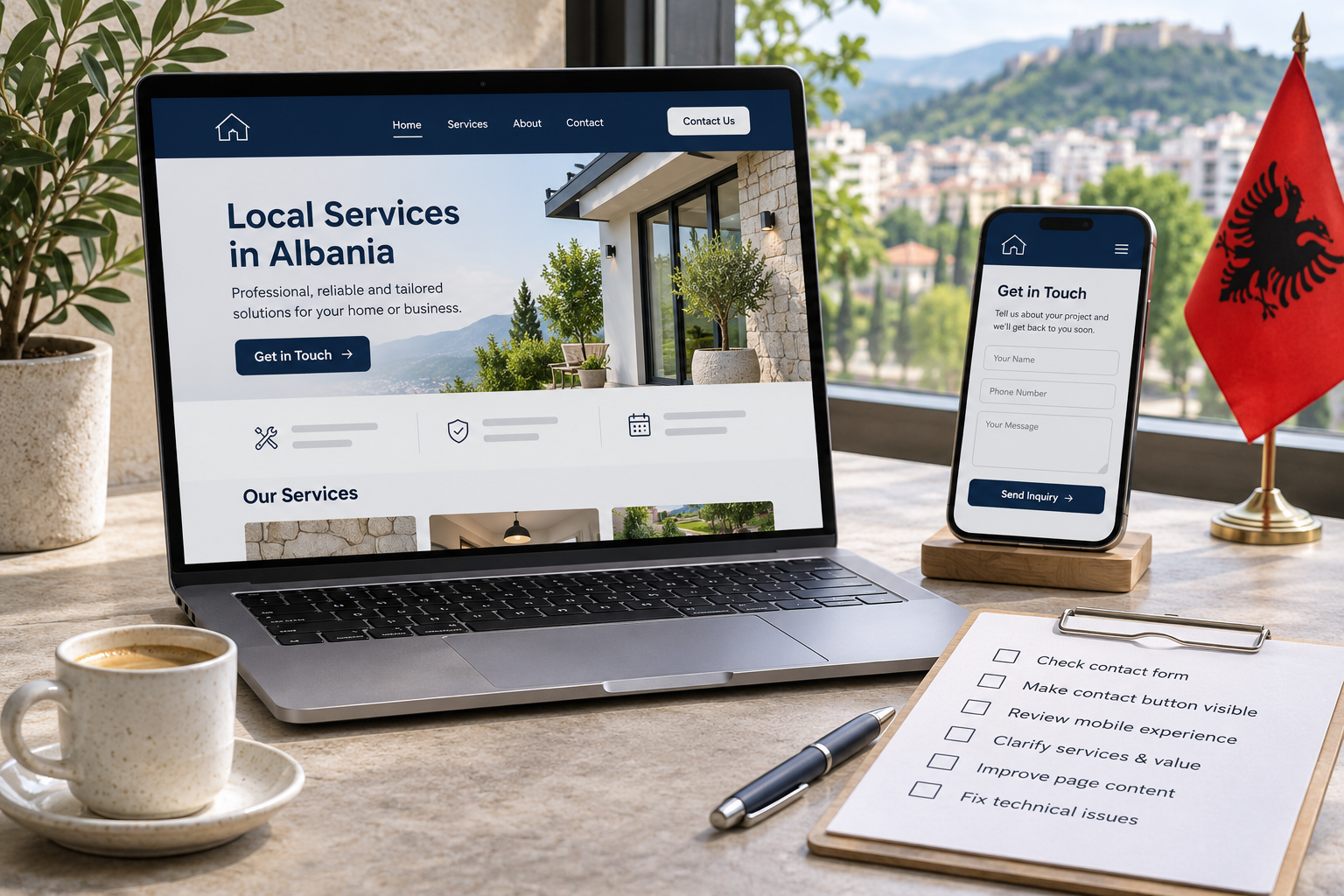
If you are researching SEO Albania because your business website brings few inquiries, start by finding where the customer journey breaks. Your important pages may be missing from Google, appearing for unsuitable searches, failing to explain your services, or losing visitors at the contact stage.
Each problem needs a different response. Publishing another blog will not repair a broken inquiry form. Changing a button will not resolve a page that search engines cannot access. A useful SEO plan connects the evidence to the work your business actually needs.
This guide explains how an Albanian business can review its website, separate search problems from conversion problems, and choose a sensible order for improvements.
Start with one service and one customer journey
Choose a service that matters commercially. It might be furniture installation, accommodation, vehicle repair, or another service your business genuinely provides. Avoid evaluating the entire website as one undifferentiated project.
Write down who needs that service, where you can provide it, which page explains it, and how someone should contact you. Then follow that route on a phone, starting from the service page and ending with a real test inquiry.
An illustrative example is a furniture workshop serving customers in Tirana and nearby areas. Its homepage might display attractive photographs without explaining whether it offers custom measurements, installation, or delivery. Visitors can see the work but still lack the information needed to request a quote.
The first useful improvement may be a complete service page and a clearer inquiry process. That decision should come from inspecting the actual website, not assuming that every business needs the same SEO package.
Use evidence to identify the main problem
Before making changes, record the current situation. Note the priority URL, available search data, successful inquiries, and any obvious technical failures. Keep observations separate from assumptions.
This table provides a starting point for investigation. None of the observations proves a cause by itself.
| What you observe | What to investigate | Practical first action |
|---|---|---|
| A priority page is not indexed | Access, indexing controls, page content, and reported status | Inspect the specific URL in Search Console |
| A page is indexed but rarely appears | Query relevance, competition, and completeness | Compare the page with the customer’s actual need |
| Impressions appear but clicks are limited | Search position, intent, title, and competing results | Review the queries and page together |
| Visits arrive but inquiries do not | Offer clarity, trust, mobile usability, and contact flow | Complete the customer journey yourself |
| Form submissions appear successful but no email arrives | Message delivery and integration behavior | Trace a test submission to the receiving inbox |
Several problems can exist at once. Repair failures that prevent contact or access while investigating the longer-term search opportunity.
Check whether important pages can be indexed
A page being accessible in your own browser does not establish that Google can index it. Ask for a review of the page’s response status, indexing instructions, rendered content, and access restrictions.
Google’s technical requirements for Search identify basic eligibility conditions: Googlebot must not be blocked, the page must return a successful response, and it must contain indexable content. Meeting those conditions does not guarantee indexing.
Use the URL Inspection tool for the exact address you want customers to find. Record the reported reason when the page is excluded, and investigate that reason rather than repeatedly submitting the URL without changing anything.
Keep the initial review focused on valuable public pages. A service page, product category, or location page can deserve attention before an old tag archive. The objective is to make useful business information accessible and understandable.
Look at searches that match your offer
Google Search Console’s Performance report shows impressions, clicks, click-through rate, and average position. You can examine the data by dimensions including page, query, country, and device.
Start with the page for your chosen service. Compare the searches it appears for with what that page actually offers. A page receiving attention for informational questions may need a different next step from a page found by customers ready to request a quote.
For an Albania-focused campaign, examine country data where available, but do not discard overseas visitors automatically. A customer planning a trip, buying for family, or arranging work remotely may search from another country.
Compare consistent date ranges and avoid drawing conclusions from a handful of impressions. If you have little data, treat early changes as hypotheses to evaluate, not proof that the strategy has succeeded or failed.
Build service pages that help people decide
A useful service page should explain what you do, who the service is suitable for, where it is available, and what happens after someone contacts you. Add the information a customer would otherwise need to ask by phone.
For the furniture workshop example, this might include materials, measurement arrangements, examples of completed work, and the information required for an estimate. Use only details the business can confirm.
Replace vague claims with specific explanations. “High-quality solutions” tells a visitor very little. Describing how measurements are collected, which design choices are available, and what the quotation includes gives the reader something concrete to evaluate.
Use photographs and project descriptions where you have permission and accurate information. Explain what the project involved without inventing performance results or presenting stock photography as evidence of your own completed work.
A strong page can also clarify limitations. If you do not offer emergency appointments, international delivery, or a particular type of installation, honest wording prevents unsuitable inquiries and wasted time.
Make local information accurate and useful
For businesses with a customer-facing presence or eligible service operations, Google Business Profile can be part of local search work. Review the existing profile before creating another listing, and confirm that the business qualifies for the service.
Google’s local ranking guidance explains the importance of complete, accurate business information and identifies relevance, distance, and prominence as key factors. Profile improvements cannot eliminate distance or guarantee a particular position.
Check that customers can find the correct contact number, opening hours, and service information. Resolve genuine contradictions between the website and profile, such as an old number or an address where the business no longer operates.
Local relevance should also appear naturally on the website. State where work is available and explain any travel or delivery arrangements. Do not claim offices in Tirana, Durrës, or another city unless they actually exist.
If you serve several locations, give each proposed location page a reason to exist. Useful differences may include actual project examples, delivery conditions, or a distinct service offering. Changing only the city name provides little help to the reader.
Use the language your customers understand
Choose language coverage around the customers you can serve. An Albanian-language service page may be important for domestic customers, while English content can help explain an offer to international buyers or visitors.
Avoid assuming that the same wording works equally well for every audience. A local customer may recognize an area name immediately; an overseas visitor may need a clearer description of where the business operates and how to arrange an appointment.
Review translated service names, inquiry options, and confirmation messages together. The website should use consistent terminology throughout the journey. If the page is in English but the contact process becomes difficult to understand, the visitor may stop before submitting anything.
Language choice should follow your real market. It does not require pretending to operate from another country or promising support in languages your team cannot handle.
Test the contact path before buying more traffic
Open your priority page on a phone. Can you understand the offer without hunting through menus? Is the next step visible? Does the contact button work? Can you send an inquiry without unnecessary fields or confusing errors?
Submit a test using realistic details. Confirm that the receiving team gets the message and has enough information to respond. A success message on the website is only one part of the process.
Check every contact channel you promote. A phone link should dial the correct number. A messaging link should open the intended account. A booking link should lead to an active calendar with understandable instructions.
Finally, consider what happens inside the business. If inquiries arrive but remain unanswered, improving search visibility alone will not solve the problem. Assign responsibility for checking messages and following up, and make response expectations realistic.
Prioritize SEO work by the problem it solves
You do not need to change everything at once. Begin with technical failures and broken customer actions. Then improve the information on your highest-priority service pages and address gaps in relevant search coverage.
A practical first cycle could follow this order:
- Record the current page, search evidence, and inquiry process.
- Repair access problems and failed contact actions.
- Improve one commercially important service page.
- Correct inaccurate local business information.
- Review the resulting search and inquiry evidence before expanding the work.
Keep a change log with dates and affected URLs. When several changes happen simultaneously, it becomes harder to know which one helped or whether the result reflects seasonality, a campaign, or another factor.
Ask an SEO provider to explain the purpose of each task, the evidence behind it, and how progress will be reviewed. A list of activities is less useful than a clear connection between the work and a specific business problem.
Measure qualified inquiries alongside visibility
Search impressions and clicks help explain discovery, but they do not tell the whole business story. Track whether inquiries concern services you provide, fall within your coverage, and contain enough information for a useful response.
Keep a simple record of inquiries, quotations, and accepted work. Where reliable attribution is available, connect that information to the originating page or channel. Where it is unavailable, acknowledge the gap rather than assigning every new customer to SEO.
This makes reporting more useful. Increased traffic with unsuitable inquiries suggests a different problem from improved visibility accompanied by relevant requests. Both deserve investigation, but the next action will differ.
Get a focused review of your website
I’m Amarildo Prendi, based in Lezhë, Albania, working remotely with businesses worldwide. My technical SEO and website performance services address areas including crawlability, page structure, and performance, while my portfolio shows examples of broader website work.
If your business needs help with SEO in Albania, send me your website URL and main service. Include the customers you want to reach and whether the main concern is visibility, missing pages, or a lack of inquiries. That gives us a concrete starting point for discussing the right scope of work.