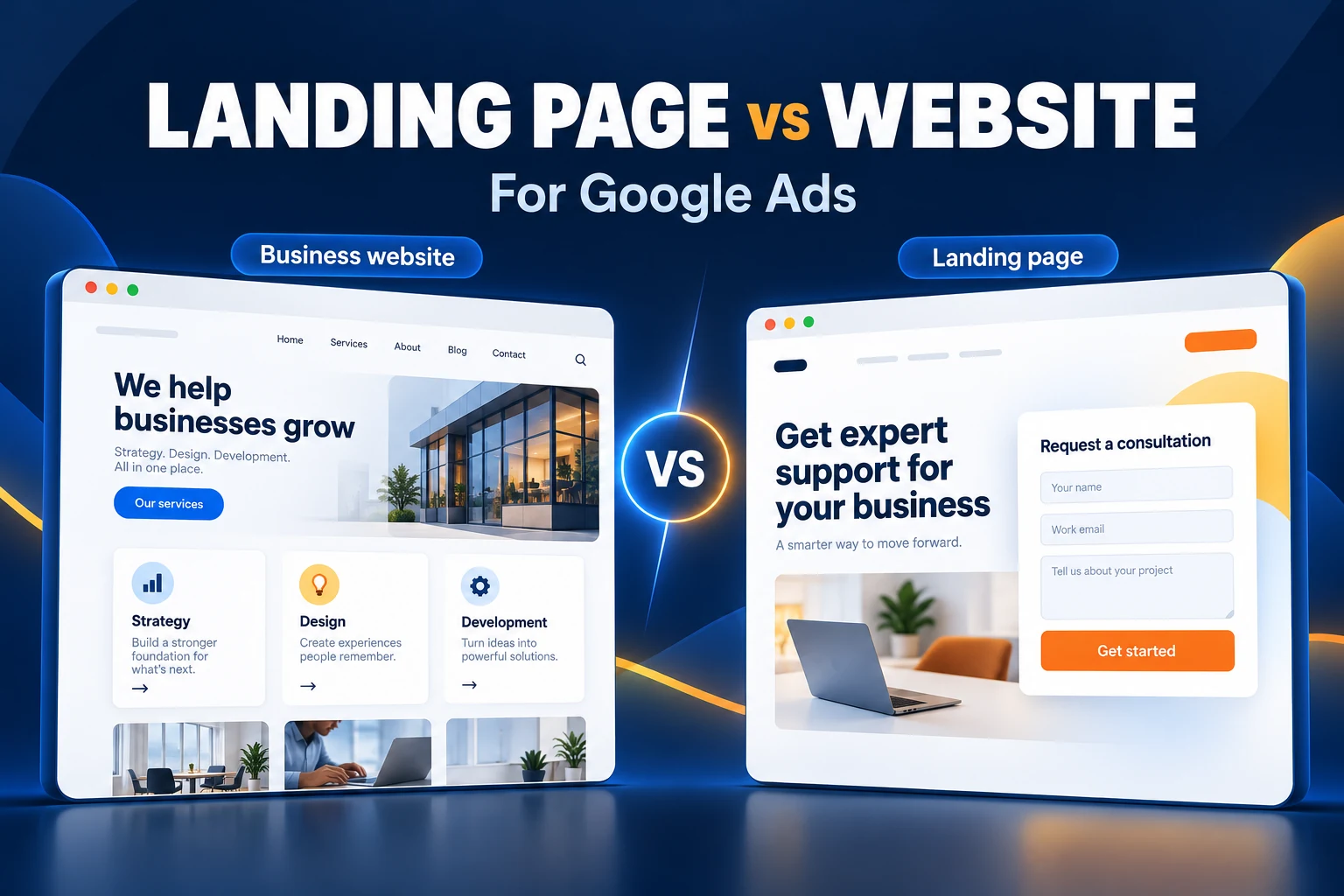
The landing page vs website decision for Google Ads starts with what the visitor needs after clicking. Use a dedicated landing page when your campaign promotes a specific service, audience or offer that your existing website does not explain clearly. Use an existing service page when it already answers the visitor’s questions and provides an easy next step.
Your homepage can also be suitable when someone searches for your business by name or needs an introduction to your main offering.
You do not automatically need a separate website for advertising. You need a relevant destination that works well, explains the offer and lets you measure meaningful inquiries.
A landing page can be part of your website
The phrase “landing page vs website” makes the options sound separate. In practice, a landing page can live on your existing domain and use the same content management system.
For example, a plumbing business might have a homepage, an emergency plumbing page and a campaign page for boiler installation quotes. All three belong to the same website.
Their jobs differ. The homepage introduces the business. The service page explains an ongoing service. The campaign page presents a focused offer to a particular audience.
Google’s landing page definition refers to the page people reach after clicking an ad. That destination does not have to use a special builder or a separate domain.
The useful question is whether the page fits the reason someone clicked.
Compare the three main destinations
Before commissioning a new page, compare what your website already offers.
| Destination | A suitable use | What to check |
|---|---|---|
| Homepage | Business-name searches or a simple business with one main offering | Can visitors immediately find the relevant service and contact option? |
| Service page | Searches for a clearly defined service | Does the page explain scope, suitability, evidence and the next step? |
| Dedicated landing page | A specific campaign, audience or offer | Does the campaign need messaging or a process the existing pages cannot support? |
These are starting points for a decision. The page’s actual content and behavior matter more than its label.
A well-built service page may serve a campaign better than a thin landing page with a large button and little useful information.
When your homepage can be enough
Consider a business with one primary service and a clear homepage. Its opening section explains what it does, where it works and how to request a quote. The rest of the page includes relevant work, service details and answers to common questions.
If the ad promises that same service, the homepage may already provide a suitable destination.
Business-name searches are another situation to consider. Someone searching for your company may want your contact details, opening hours or an overview of your work. A homepage can help them navigate those needs.
The problem appears when the homepage asks visitors to start their search again. An ad for commercial cleaning should not send people to a page dominated by household cleaning, recruitment notices and unrelated services.
Open the destination on a phone and read its first screen. Can you tell that the business offers what the ad promised? If the answer requires several menu choices, another destination may be more useful.
When an existing service page is the better choice
A service page is worth considering when it already covers the exact work you advertise.
Imagine a company running ads for deck replacement. Its replacement page explains when replacement may be appropriate, the materials available, the quoting process and examples of completed work.
That page may need a clearer inquiry form or stronger mobile layout. It may not need rebuilding as a separate campaign page.
Google recommends choosing a destination that closely matches the ad and keywords. Its guidance on optimizing ads and landing pages also emphasizes clear actions, mobile usability and useful information. Google Ads Help
Review the service page against the campaign promise. If the ad offers a written estimate, explain how someone requests it. If the business serves a limited area, make that clear before the form.
Small, targeted improvements can be a sensible first step when the underlying page already serves the right audience.
When a dedicated landing page is justified
A dedicated page becomes useful when the campaign needs a different conversation from the rest of your website.
You might promote a fixed-scope website package to dental practices while your main development page serves many industries. A dedicated page can explain the package, show relevant work and answer questions specific to that audience.
Other examples include an event registration campaign, a seasonal service offer or a product demonstration request.
The case for a new page should be concrete. Write down what the existing destination cannot explain or support. That might be a different offer, a shorter booking process or a need to test campaign-specific messaging.
“Landing pages convert better” is too broad to serve as a project brief. Define what you expect the new page to improve and how you will assess it.
Match the offer from the ad to the page
Consider this hypothetical ad:
Boiler Installation Quotes — Request a Written Estimate
The destination should quickly explain boiler installation, who can request a quote and what happens next. It should also describe any conditions that affect the estimate.
A page headed “Complete Property Solutions” makes visitors work harder to confirm they are in the right place.
The opening heading does not need to repeat every word in the ad. It needs to preserve the meaning. The service, offer and next action should remain consistent.
Avoid advertising a price, deadline or service area that the destination does not explain. Clear conditions help suitable customers decide whether to continue.
Give visitors enough information to make a decision
A focused page still needs substance.
For a service business, visitors may need to know what the service includes, which problems it addresses, where it is available and how the business handles inquiries.
Use evidence that belongs to the business. That could include genuine project photos, a relevant work example or a customer review used with permission. Explain what the evidence shows rather than adding it as decoration.
Keep links that help visitors make an informed choice, such as access to business information or privacy details. Review unrelated promotions and navigation choices that compete with the campaign’s purpose.
There is no universal rule that every landing page must remove its menu. Choose the navigation based on what buyers need to understand and verify.
Design the contact process around the inquiry
A form should collect enough information for a useful response.
An emergency repair inquiry may need a phone number, location and a short description. A software project inquiry may need more detail about scope and requirements.
Do not remove fields simply to make the form shorter. Ask whether each field helps the business respond or qualify the request.
Explain the next step near the form. Tell visitors whether they are requesting a callback, booking a meeting or asking for an estimate. Only state response times the business can reliably meet.
Test the full interaction on mobile. Check field labels, validation errors, keyboard behavior and confirmation messages. A page can look polished while its form fails at the moment a visitor tries to contact you.
Measure qualified inquiries before declaring a winner
Decide what counts as success before comparing destinations.
A button click, an accepted inquiry and a qualified sales opportunity describe different outcomes. Choose measurements that reflect the campaign’s business goal.
For example, record accepted contact submissions, then review how many concern the advertised service and fall within the business’s coverage area.
A useful calculation is:
Cost per qualified lead = advertising spend ÷ qualified leads
In a hypothetical campaign, $600 in advertising spend producing six qualified inquiries gives a cost of $100 per qualified lead. This example illustrates the calculation; it is not a forecast or benchmark.
Compare outcomes over a period that gives leads time to arrive and be assessed. Avoid changing the page, offer, targeting and budget together if you want to understand what caused a difference.
For help defining and validating these measurements, see my analytics setup and conversion optimization service.
Brief the page before paying for development
A useful landing-page brief can be short, but it should answer clear questions.
Identify the audience, the advertised service and the action you want visitors to take. Provide the campaign promise, any offer conditions and evidence the designer can use.
Also define where inquiries should go and who will test their delivery. Include responsibility for copy, mobile checks, tracking and future edits.
If the existing service page can meet the brief with a few improvements, update it first. If the campaign needs a distinct offer or process, build a dedicated page around that requirement.
You can review my landing page design and development service for support with messaging, responsive development, contact integrations and measurement. The starting point is your campaign’s goal and the page your customers need to reach it.