Your website is live. Customers are visiting it. Your business depends on it.
Then something goes wrong.
Maybe your contact form stops sending inquiries. Perhaps a WordPress update breaks your layout. Or your marketing team needs a new landing page, but nobody is available to build it.
You search for a freelance web developer, receive several quotes, and face an important decision:
Should you hire someone for one project, pay for ongoing monthly support, or bring in a remote developer for a longer-term contract?
The right choice depends on how frequently your website needs work, how important it is to your business, and whether you need occasional fixes or continuous development.
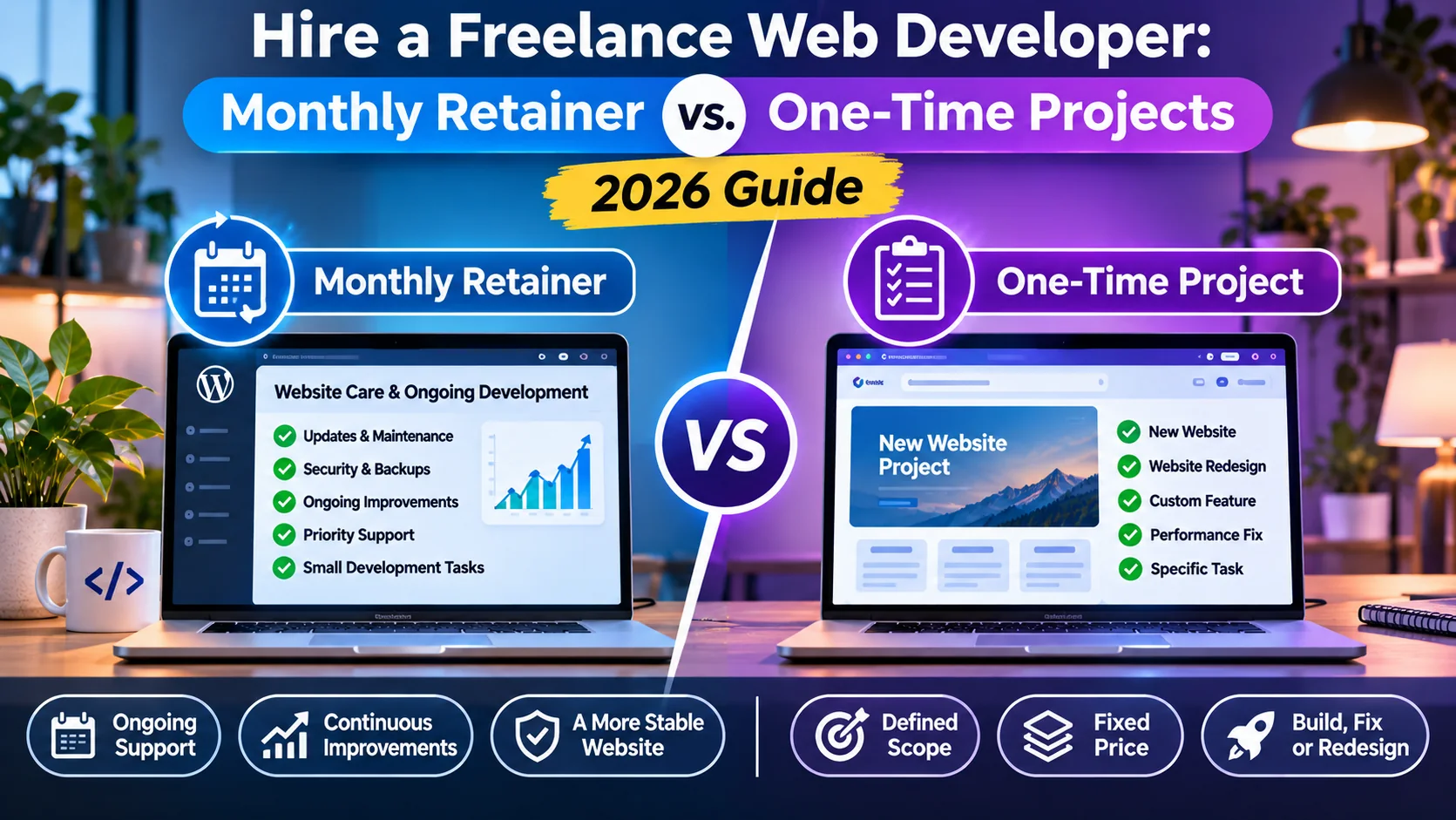
A one-time project can be the most economical solution when the work has a clear beginning and end. A monthly retainer is often more appropriate when a website requires recurring maintenance, updates, or technical attention.
And when your company has a steady development workload, hiring a dedicated remote freelancer may make more sense than repeatedly assigning separate projects.
This guide explains how to choose the right arrangement, what to include in your contract, and how to evaluate a freelance developer before hiring.
Why More Businesses Consider Freelance Web Developers
A company does not always need a permanent in-house web developer.
Small businesses may need someone to maintain their WordPress website, make occasional improvements, and resolve technical issues.
Marketing agencies may require additional development capacity when client projects increase.
Startups might need a developer to build and improve an early product without immediately expanding their permanent team.
Freelancers can help meet these different needs through flexible contractual arrangements.
However, hiring an independent developer should not mean accepting unclear expectations or unpredictable delivery.
The most effective arrangements define responsibilities, timelines, communication, technical access, and the conditions under which additional work is billed.
Before choosing a freelancer, you should understand the different hiring models.
Option 1: Hire a Freelance Web Developer for a One-Time Project
A fixed-price development project is appropriate when the deliverables are relatively clear.
For example, you might need a new five-page business website, an existing website redesigned, or a checkout problem resolved.
The developer reviews the requirements, estimates the work, and agrees to a defined scope.
Common One-Time Web Development Projects
Businesses frequently hire freelancers for work such as:
Developing a new business website.
Redesigning an existing WordPress website.
Building a campaign landing page.
Fixing a specific PHP or JavaScript error.
Improving website loading speed.
Creating a WooCommerce store.
Migrating a website to another hosting provider.
Implementing analytics and conversion tracking.
Developing a custom feature or integration.
These projects have identifiable outcomes.
For example, a landing page project may include a responsive layout, working inquiry form, analytics events, and tested deployment.
Once those deliverables are accepted, the initial project is complete.
Advantages of Fixed-Price Projects
The main advantage is budget clarity.
You know what you are purchasing and can compare proposals against specific requirements.
A fixed-price contract also makes it easier to define acceptance criteria.
Instead of paying for an unspecified number of hours, you can agree on what the finished website or feature must accomplish.
Disadvantages of One-Time Projects
The main limitation appears after delivery.
What happens if your website needs another change two weeks later?
What if a third-party integration fails?
What if your business needs ongoing updates?
Unless post-launch support is included, you may need to arrange another contract.
This is not necessarily a problem for a simple website. But for a website that supports daily business operations, repeated one-time projects can become inconvenient.
Best for: Businesses with clear, limited development requirements and no immediate need for ongoing technical support.
Option 2: Hire a Freelance Web Developer on a Monthly Retainer
A monthly retainer is an ongoing agreement between a business and a freelancer.
Instead of contacting a developer only when something needs fixing, the business pays for an agreed scope of recurring services or reserved development capacity.
The exact arrangement varies.
A basic website maintenance retainer may cover updates, backups, monitoring, and small content changes.
A larger development retainer may include regular feature development, technical improvements, integrations, and scheduled development work.
These services should not be confused.
Website Maintenance Retainer
A maintenance retainer focuses on keeping an existing website operational and manageable.
For a WordPress website, the agreement might include:
WordPress core and plugin updates.
Backup verification.
Website uptime checks.
Security-related maintenance.
Small content adjustments.
Performance checks.
Basic technical troubleshooting.
Periodic maintenance reporting.
The purpose is to reduce neglected maintenance and provide a consistent technical contact.
However, a maintenance plan does not automatically include unlimited development, emergency recovery, or a guaranteed response time.
Those responsibilities should be explicitly defined.
Development Retainer
A development retainer covers more substantial ongoing technical work.
For example, a digital marketing agency may need a freelance developer to implement landing pages, improve Core Web Vitals, resolve WordPress issues, and integrate third-party services throughout the month.
Rather than requesting a separate quote for every small task, the agency can reserve agreed development capacity.
The arrangement may include a monthly allocation of hours, defined deliverables, or a prioritized task backlog.
For teams with recurring work, this can simplify planning.
Advantages of a Monthly Retainer
A retainer can reduce the need to repeatedly search for a developer.
It also gives the freelancer more context about the website.
Someone who understands your WordPress configuration, custom integrations, hosting environment, and business priorities may be able to investigate future issues without rediscovering the entire system.
The arrangement can also support preventive work.
Instead of waiting for a problem to become visible, routine checks can identify issues earlier.
Disadvantages of a Monthly Retainer
A retainer is not always the best choice.
If your website rarely changes and your hosting provider already handles much of the maintenance, a large monthly contract may provide little additional value.
Poorly defined retainers can also create disagreements.
For example, the business may assume a complete redesign is included, while the freelancer considers it a separate project.
A useful retainer should therefore explain exactly what is included, excluded, and subject to separate approval.
Best for: Businesses with active websites, recurring technical needs, multiple integrations, or regular development requests.
Option 3: Hire a Dedicated Remote Freelance Web Developer
Some companies need substantially more than occasional maintenance.
A growing agency might manage dozens of customer websites.
A software company may have continuous frontend and backend development tasks.
A startup might need someone available throughout the working week to develop features and resolve issues.
In these situations, a dedicated remote freelancer can be a practical alternative to purchasing individual projects.
How Dedicated Remote Development Works
A business agrees to a recurring contractual arrangement with an independent developer.
The agreement defines the working hours or capacity, responsibilities, payment terms, communication channels, and project priorities.
For example, a developer may work on WordPress maintenance one day, frontend improvements the next, and API integration tasks later in the week.
This arrangement differs from a basic website care plan.
The business is purchasing development capacity rather than a limited collection of maintenance tasks.
When a Dedicated Developer Makes Sense
Consider this model when:
Your team has consistent weekly development requirements.
Multiple websites need coordinated technical work.
Your agency needs additional production capacity.
You are building a product with frequent updates.
You require continuity across several technical systems.
Project-by-project contracting creates unnecessary administrative work.
A dedicated developer can also become familiar with the team's workflows, coding standards, and business priorities.
However, businesses should remember that contractor arrangements are not identical to employment.
Contracts, tax responsibilities, and classification requirements depend on the applicable jurisdiction and the actual working relationship.
How Much Does It Cost to Hire a Freelance Web Developer?
There is no universal price for freelance web development.
Costs vary according to technical complexity, experience, scope, contract structure, and support expectations.
A simple visual adjustment is not comparable to building a custom eCommerce application.
Similarly, monthly maintenance is not equivalent to reserving a full-time developer.
Fixed-Price Development
For a defined project, evaluate the total deliverables.
As an example, my published packages at AmarildoPrendi.com include:
Business website development: Starting at $1,500.
Conversion landing page development: Starting at $750.
Website speed improvement: Starting at $400.
These are starting prices for specific services I offer, not average market rates.
A final quote depends on requirements and the condition of the existing website.
Monthly Website Maintenance
My monthly website care package starts at $175 per month.
It focuses on routine technical care and small website improvements.
Businesses with complex WooCommerce stores, custom infrastructure, or demanding support requirements may need a broader agreement.
Dedicated Development
A dedicated monthly contract is priced differently because it involves a larger recurring workload.
For companies considering a longer-term remote arrangement, the important question is how much development capacity they need.
A business should compare the expected workload, technical requirements, availability, and total contract cost before choosing.
A lower monthly price is only attractive if the developer can reliably deliver the required work.
Monthly Retainer vs One-Time Project: A Practical Cost Example
Consider a hypothetical small business that needs occasional WordPress help.
Over three months, it expects:
A plugin conflict to be investigated.
Two landing page adjustments.
Routine WordPress updates.
Contact form testing.
Several minor content changes.
If the business hires a freelancer separately for each task, the total cost depends on the developer's rates and the hours required.
Suppose the work requires three hours in month one, five hours in month two, and two hours in month three.
At a hypothetical rate of $60 per hour, that equals $600 over three months.
Now compare that with a hypothetical maintenance arrangement at $175 per month.
That would cost $525 over the same period.
But this does not prove the retainer is cheaper.
The maintenance agreement might exclude the landing page adjustments or limit the number of included development hours.
The hourly contract may also provide a different response time or level of technical expertise.
The important comparison is the cost of equivalent work and support, not just the headline price.
Before deciding, request a written scope and identify which tasks would require additional payment.
The Hidden Cost of Hiring a Different Developer Every Month
Hourly billing can be efficient for occasional projects.
However, switching freelancers repeatedly may introduce additional work.
Each developer may need to understand your hosting setup, theme structure, custom code, plugins, and deployment process.
They may need access to accounts, documentation, and previous project decisions.
For a complicated website, this onboarding can consume time.
Consider a business with a custom WordPress theme and several third-party integrations.
A new freelancer asked to fix one issue may first need to understand how the system was built.
If another problem appears next month, a different developer may repeat parts of that investigation.
A consistent developer can retain useful project context.
That does not mean you should remain with an unsuitable freelancer simply to avoid changing providers.
It means technical continuity has value, particularly when your website is complex.
Documentation, version control, and clear access management can reduce dependency on any one person.
What Should Be Included in a Freelance Developer Retainer?
Before signing a monthly contract, define the work carefully.
A useful agreement should answer the following questions.
What Work Is Included?
Specify whether the arrangement covers routine maintenance, content updates, custom coding, design changes, or development tasks.
Avoid vague promises such as "unlimited website support" unless the limits and conditions are clearly explained.
How Much Capacity Is Available?
If the contract includes development time, define the monthly allocation and how it is measured.
For example, explain whether planning, meetings, testing, and deployment are included within that capacity.
How Quickly Will Requests Be Handled?
Response time and resolution time are different.
A developer may acknowledge an issue quickly without being able to resolve it immediately.
Agree on reasonable communication and prioritization expectations.
For business-critical websites, emergency response commitments may require a separate support agreement.
Who Owns the Code and Accounts?
The business should understand who controls its hosting, domain, source code, databases, and third-party services.
The agreement should also address intellectual property, license restrictions, confidentiality, and access removal when the contract ends.
How Are Larger Projects Handled?
A monthly maintenance plan may reasonably exclude a complete redesign.
Similarly, a development retainer may require a separate estimate for work exceeding the agreed capacity.
Defining these boundaries protects both parties.
How to Find a Reliable Freelance Web Developer
Whether you hire someone for one project or ongoing support, technical ability should be evaluated alongside reliability.
Review Relevant Portfolio Projects
Look for websites similar to the one you operate.
If you run a WooCommerce store, experience with eCommerce functionality matters.
If you manage a local service company, look for examples of service-focused websites, clear inquiry paths, and mobile-friendly design.
You can review examples of my work on my web development portfolio.
Ask About Technical Skills
WordPress developers should understand more than page builders.
Depending on the project, relevant skills may include PHP, JavaScript, HTML, CSS, database operations, APIs, and hosting configuration.
For custom web applications, React, Next.js, Node.js, and other technologies may be relevant.
A good developer should be able to explain why a particular solution fits the project.
Discuss Testing and Backups
Before changing a production website, ask how the freelancer will test the work.
Discuss staging environments, backup procedures, version control, and rollback plans.
This is particularly important for WooCommerce websites and other systems that process active business transactions.
Evaluate Communication
You should understand how progress will be communicated and who will be responsible for decisions.
Clear updates and realistic commitments are more useful than vague promises about completing everything immediately.
Start With a Defined Task
If you are uncertain about a developer, begin with a small, clearly scoped task.
This can help you evaluate communication, technical reasoning, and delivery quality before committing to a larger contract.
Should You Hire a Freelancer Locally or Remotely?
Many website development tasks do not require physical presence.
A developer can work remotely on WordPress, WooCommerce, custom web applications, APIs, website performance, and technical SEO.
For international companies, remote collaboration can broaden the available talent pool.
However, successful remote work requires clear access procedures, communication expectations, and agreed working hours.
I'm an independent web developer based in Albania and work remotely with international businesses.
My location allows convenient time-zone overlap with many European companies, including those in Germany, Austria, Switzerland, and Italy.
For US and Canadian companies, collaboration can be structured around agreed meeting times and asynchronous updates.
The important factor is not whether the developer lives nearby.
It is whether the working arrangement fits the business and the developer can deliver the required work.
Freelance Web Developer vs Agency: Which Should Your Business Choose?
An agency may be appropriate when your project requires several specialized roles.
For example, a large website redesign may need dedicated branding, UX research, design, frontend development, backend development, and quality assurance.
An individual freelancer can be suitable when the work primarily requires a specific technical skill set.
Direct communication with the person implementing the solution can simplify feedback and decision-making.
However, a single freelancer has finite capacity and may not provide the same coverage or specialist breadth as a larger team.
Some businesses use both arrangements.
They hire an agency for major projects and retain an independent developer for ongoing maintenance and improvements.
The correct choice depends on complexity, budget, internal resources, and support requirements.
Seven Signs Your Business May Need Ongoing Web Development Support
Not every company needs a developer every month.
However, recurring problems can indicate that occasional hiring is no longer the most effective approach.
1. Your website frequently develops technical issues.
Repeated plugin conflicts, broken layouts, or errors suggest the need for investigation and a more consistent maintenance process.
2. Your marketing team regularly needs new pages.
If campaigns depend on landing pages, forms, and tracking updates, reserved development capacity can reduce scheduling friction.
3. Your website generates important customer inquiries.
When lead generation matters to your business, regular testing of forms and other conversion paths can be valuable.
4. Your online store needs frequent changes.
WooCommerce and other eCommerce platforms may require careful testing of payment, inventory, and checkout functionality.
5. Nobody is responsible for technical maintenance.
Without clear ownership, important updates and recurring issues can be overlooked.
6. You repeatedly explain the same website structure to new freelancers.
A consistent developer may reduce unnecessary onboarding and investigation.
7. Your company has a growing development backlog.
When new technical requests appear every week, a recurring arrangement may be easier to manage than separate contracts.
If several of these situations apply, evaluate whether a maintenance retainer or a broader development agreement would better support the business.
Frequently Asked Questions
Is It Better to Hire a Freelance Web Developer Monthly?
Monthly hiring is generally more useful when your business has recurring development or maintenance requirements.
For a one-time website launch or a clearly defined technical fix, a project contract may be more appropriate.
Can I Hire a WordPress Developer for Only a Few Hours?
Yes. Many independent developers accept small, defined tasks.
Availability, minimum project fees, and hourly billing arrangements vary by freelancer.
What Is the Difference Between Website Maintenance and Web Development?
Maintenance focuses on keeping an existing website operational, updated, and manageable.
Development involves building or substantially changing functionality, layouts, integrations, and applications.
Some agreements include both, but the scope should be explicit.
Can a Remote Freelancer Manage Multiple Business Websites?
Yes, provided the workload and support expectations are realistic.
A developer managing several sites needs organized access, appropriate documentation, backup procedures, and a clear way to prioritize tasks.
Should I Pay Monthly if My Website Rarely Changes?
Not necessarily.
A stable website with limited technical requirements may only need periodic professional assistance.
The decision should account for business risk, the maintenance already provided by your hosting platform, and the amount of support you genuinely need.
Final Thoughts: Hire for the Work You Actually Need
The most expensive hiring decision is not always choosing the developer with the highest price.
Sometimes it is paying for a recurring service your business does not use.
Other times, it is repeatedly hiring someone after a technical problem has already affected customer inquiries or sales.
A one-time freelance project is suitable for defined work.
A monthly maintenance retainer can provide continuity for active websites.
A dedicated remote development agreement can support companies with an ongoing technical workload.
Choose the arrangement that matches the responsibility, availability, and technical expertise your business actually requires.
Hire Amarildo Prendi — Independent Freelance Web Developer
I'm Amarildo Prendi, an independent freelance web developer based in Albania, working remotely with businesses and agencies internationally.
I provide WordPress and WooCommerce development, custom web development, website maintenance, technical SEO, and performance optimization.
I work with technologies including PHP, JavaScript, React, HTML, CSS, and modern web development tools.
Whether you need a defined website project or ongoing technical support, I can review your requirements and discuss a suitable scope.
My published service packages include monthly website care starting from $175 per month, as well as fixed-price development options.
Explore my service packages, review my portfolio, or learn more about my WordPress development services.
You can also view my Upwork freelancer profile.
If your company is considering hiring a freelance web developer, visit AmarildoPrendi.com and share your website, the tasks you need completed, and whether you're looking for a one-time project or ongoing development support.