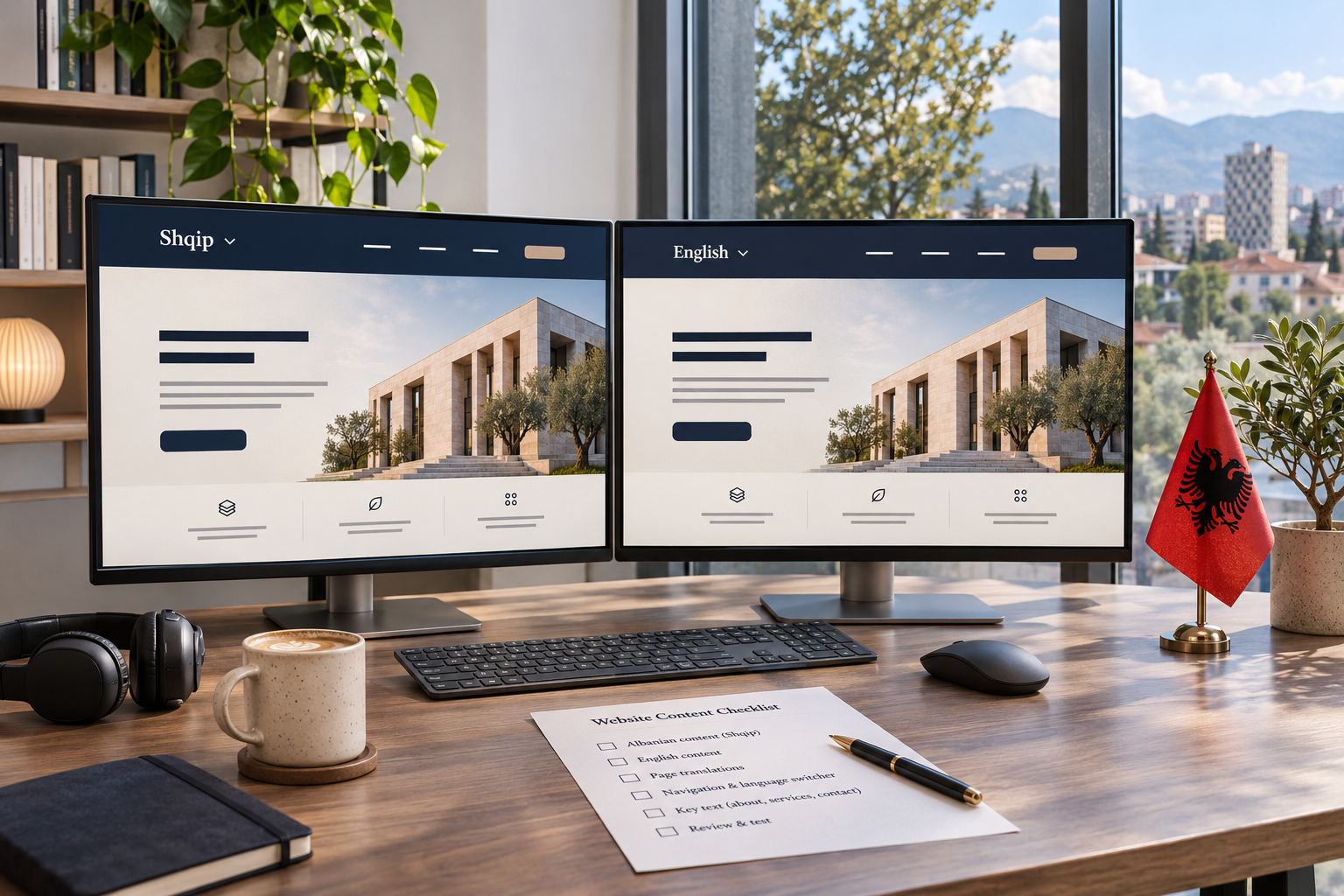
If you are hiring a freelance web developer in Albania for a bilingual website, agree on more than the design and number of pages. Your brief should identify who prepares each translation, how visitors switch languages, which forms and integrations need localization, and who keeps both versions accurate after launch.
An Albanian–English website should let customers complete the same important tasks in either language. That means understanding your services, reviewing relevant information, and sending an inquiry without unexpectedly reaching an untranslated page or confusing confirmation message.
I’m Amarildo Prendi, an independent web developer based in Lezhë, Albania, working remotely with clients worldwide. This guide explains how to plan a bilingual business website and evaluate a freelance development proposal before committing to the build.
Start with your customers and their questions
The right language plan depends on who you want to serve. A business addressing Albanian-speaking customers and international buyers may need different explanations, even when the underlying service is identical.
Consider an illustrative example: a furniture workshop in Albania that accepts inquiries from local homeowners and overseas interior designers. Local visitors may already understand where the workshop operates. An international buyer may need clearer information about project coordination, delivery arrangements, and the process for requesting a quote.
The website should answer those questions using facts the business can verify. Translation alone cannot supply missing delivery terms or explain a process that the company has not defined.
Write down the three most important actions for each audience. These might be viewing previous work, understanding available services, and requesting a quotation. Use those actions to decide which pages need to exist in both languages at launch.
Build a page plan before choosing a translation tool
A language plugin or translation service is an implementation choice. First, decide what content your customers actually need and who will maintain it.
Start with a small table containing the page, its purpose, the required languages, and the person who approves the content. This exposes missing information before it becomes a development delay.
The following is a sample plan, not a description of a completed client project:
| Page or component | Albanian version | English version | Business approval needed |
|---|---|---|---|
| Homepage | Main offer and next step | Main offer with useful international context | Positioning and service claims |
| Priority service page | Scope and relevant questions | Equivalent scope with clarified terminology | Deliverables and exclusions |
| Project gallery | Approved descriptions | Reviewed translations of descriptions | Photo permissions and factual details |
| Inquiry form | Labels, errors, confirmation | Labels, errors, confirmation | Required fields and recipient |
| Contact page | Contact details and availability | Same verified details with clear dialing information | Contact channels and response expectations |
You do not necessarily need to translate the entire archive immediately. Prioritize complete customer journeys. If an older article has no translation, decide how the language selector should behave instead of sending visitors to an unrelated page without explanation.
Separate development from translation responsibilities
A freelancer may implement the multilingual system while the business supplies approved copy. Alternatively, the project may include coordinating content preparation. The proposal should say which arrangement applies.
Ask who writes the source text, who translates it, and who checks specialized terminology. A developer’s technical ability does not automatically establish expertise in every language or industry.
Automated translation can help prepare a draft, but someone should review the meaning before publication. Pay particular attention to service limitations, measurements, delivery information, and any claims customers may rely on when deciding whether to contact you.
Keep a shared terminology sheet for repeated phrases. For example, the same service should not acquire three different English names across navigation, page headings, and inquiry options. Consistency also makes future updates easier for whoever manages the website.
Choose language URLs that can be shared and revisited
A customer should be able to copy the English service-page address and send it to a colleague who sees the same language. That becomes difficult when the page’s language depends entirely on a previous browser choice.
Google’s guidance for multilingual websites recommends separate URLs for different language versions. It also advises providing links between versions and avoiding automatic language redirects that prevent people or crawlers from accessing the alternatives.
For a new small-business site, language folders such as /sq/ and /en/ are one structure to consider. These are illustrative path patterns, not proposed changes to your existing site. An established website needs its current URLs reviewed before any restructuring.
A visible language selector should preserve the visitor’s task where an equivalent page exists. Someone reading a service page should reach that service’s translation, rather than being forced to restart from the homepage.
Ask how equivalent pages will be connected for search
The developer should explain how the site identifies corresponding language versions. Google’s localized-page documentation describes hreflang annotations, which communicate those relationships.
For an Albanian–English pair, the language codes are sq and en. Country-specific targeting is a separate decision; a page written in English is not automatically intended only for the United Kingdom or United States.
In a complete pair, each page should identify itself and its equivalent using fully qualified URLs, with reciprocal references. The developer should inspect the resulting page output or sitemap, rather than relying only on a dashboard setting that says multilingual SEO is enabled.
Ask for a small URL mapping sheet as part of the handoff. It gives your team a straightforward way to track which pages correspond when slugs or content change. These annotations do not guarantee indexing, rankings, or leads.
Localize the whole inquiry process
A bilingual page can still provide a poor experience if its contact form remains partly untranslated. Include field labels, instructions, validation errors, submit buttons, and confirmation messages in the content inventory.
Test what happens after submission. Does the inquiry reach the intended inbox? Can the business see which language the visitor used? If an automatic reply is included, does it match that language and describe a realistic next step?
Agree on how language preference is recorded. A hidden language field may be useful, but the implementation needs to preserve the value through any CRM or email integration. Avoid promising a response in a particular language unless the business can provide it.
External booking or checkout tools need separate attention. Your website may switch to English correctly while the embedded booking interface remains in Albanian, or vice versa. Include those transitions in the brief and identify any limits imposed by the external provider.
Compare proposals using the full scope
“Five pages in two languages” does not describe the entire workload. One proposal may include translation entry, menu configuration, form messages, search metadata, testing, and training. Another may cover only the visible page layouts.
Ask for an itemized scope covering content preparation, implementation, integrations, testing, and post-launch support. Confirm any recurring software costs and which account owns each paid subscription.
A useful estimating method is to count unique templates, translated content items, and workflows separately. Ten pages sharing one template create a different development workload from ten individually designed pages. Meanwhile, both projects still need their translated copy checked.
My custom web development service explains the broader development process and capabilities. For a WordPress project, the Albania WordPress freelancer hiring guide can help you evaluate the platform-specific skills alongside these bilingual requirements.
Test both languages before approving launch
Choose a realistic customer task and perform it independently in each language. Begin on a public-facing page, find a service, review the information, and submit an inquiry. Do not limit approval to opening the two homepages.
Use this acceptance checklist with your developer:
- Navigation, buttons, and key page content use the selected language consistently.
- Switching languages opens the correct equivalent page when available.
- Untranslated pages have an intentional, understandable fallback.
- Long translated headings and buttons remain usable on mobile.
- Required-field errors and successful submission messages are understandable.
- Test inquiries arrive with the expected details and language information.
- External booking or payment steps behave as agreed.
- The business can edit each version without accidentally replacing the other.
Ask someone who did not build the website to repeat the main task. Give them a goal rather than instructions about which button to click. Their questions can reveal confusing labels or missing information that the project team has stopped noticing.
Assign responsibility for updates after launch
The two versions will drift apart unless updates have an owner. A new service, changed contact number, revised opening hours, or discontinued offer may require changes in several places.
Use a simple content status for each page: source updated, translation needed, translation reviewed, and published. The exact software matters less than having a visible process that prevents an outdated version from being forgotten.
Request a brief editing demonstration during handoff. Your team should know how to update a translated page, preview it, adjust its menu label, and check that the language relationship still works.
Agree on maintenance responsibilities separately from content production. Technical updates do not automatically include translating new pages, rewriting service descriptions, or checking every external integration after a provider changes its interface.
Can an Albania-based freelancer build for international customers?
Yes, a website project can be delivered remotely when access, communication, and responsibilities are clear. The developer’s location does not need to match every country your business serves.
Your actual audience should determine the site’s language and content requirements. Being based in Albania does not mean your website must address only Albanian customers, and adding English does not require pretending to have an office abroad.
Describe your real service coverage and how remote communication works. For businesses serving customers internationally, clarity about availability, project coordination, and the inquiry process is more useful than unsupported claims of local presence.
Discuss your bilingual website project
I work from Albania with businesses worldwide on website development and technical improvements. You can review my portfolio for examples of my broader development work; the scope of a bilingual project should be agreed around your specific content and workflow requirements.
If you need a freelance web developer in Albania for a bilingual website, send me your website brief. Include your current URL, required languages, priority pages, available translations, and the action customers should take. Those details provide a useful starting point for discussing the structure, responsibilities, and development scope.