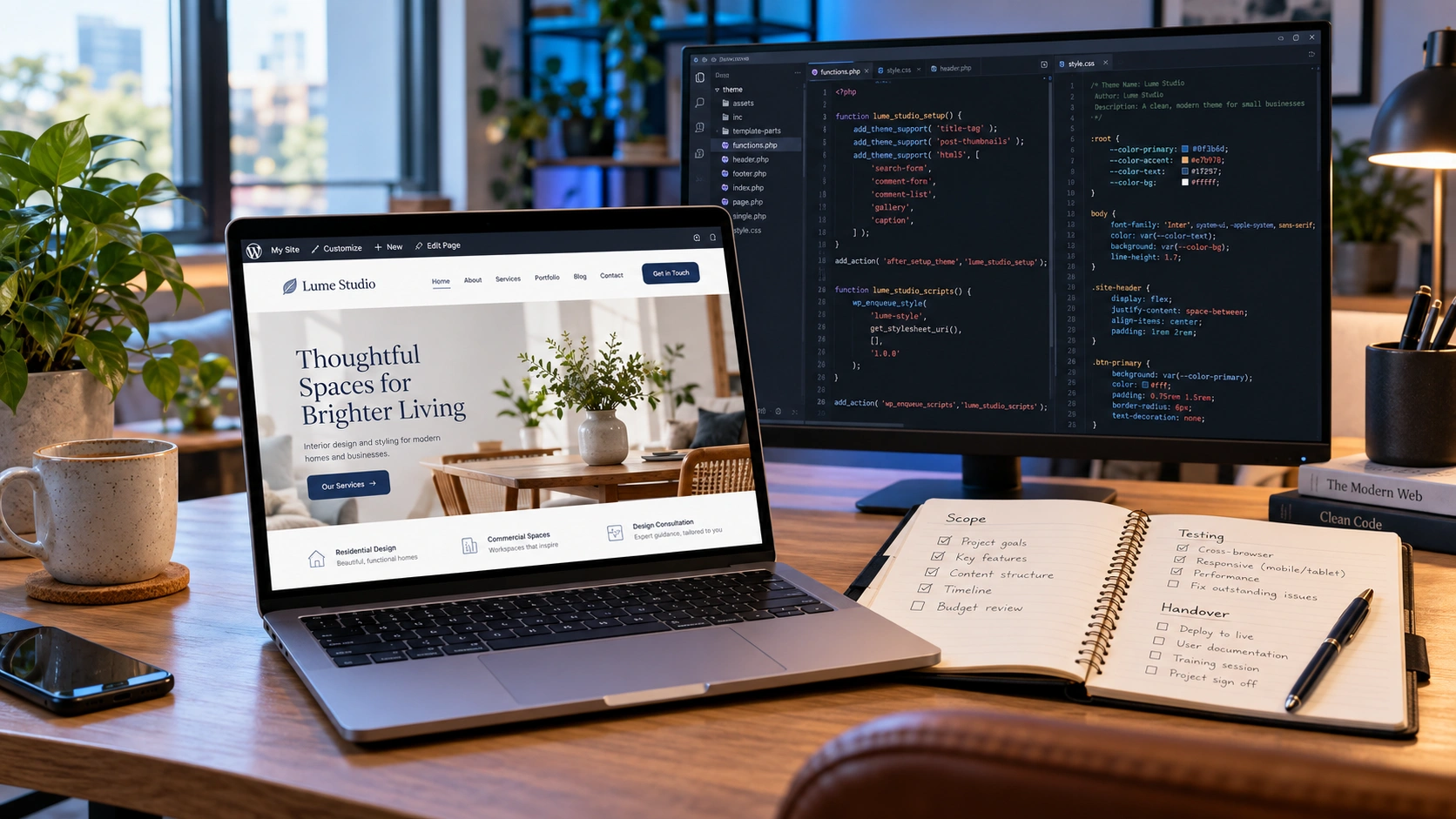
To hire a WordPress developer, start with the business problem you want to solve. Ask candidates for relevant work, a clear explanation of their role and a proposal that defines the scope, testing and handover. Choose someone who can explain how the website will work for customers and how your team will manage it after launch.
A polished portfolio is useful, but it only shows part of the picture. You also need to understand who built the features, what tools the website depends on and how changes will be handled. These questions help you compare proposals on the same basis before committing to a project.
Write a short brief before asking for a quote
Explain what the website should help people do. A service business may want visitors to understand an offer and request a quote. A store may need a simpler checkout. An existing website may require repairs rather than a full rebuild. Describe the current problem and the outcome you want in plain language.
Include the main pages, required features, existing integrations and who will supply content. Share examples of designs you like, but explain what you like about them. A clean menu, a useful product filter and an attractive color palette are different requirements.
For example, a useful brief might say: “We need five service pages, a quote form that reaches our sales inbox and an editor our office team can use.” That gives a developer more to assess than “We need a modern website.” Include your deadline and budget range so the proposed approach fits your constraints.
Match the developer’s work to your project
Ask for two or three projects that involve similar work. A developer who builds content websites may be a good match for a service business. A project involving subscriptions, payment rules or custom integrations needs evidence of those capabilities.
For each example, ask what the developer personally handled. Did they design the interface, build templates, write custom code or maintain an existing site? Work completed within a team can still be relevant when the role is clear. A demonstration project can also show skill if it is described honestly.
Look beyond the homepage. Use the navigation on a phone, open an inner page and inspect the main customer action. Live websites can change after delivery, so ask how the current version differs from the developer’s work. Give candidates a chance to explain decisions and constraints rather than judging screenshots alone.
Ask how normal content will be edited
Before choosing a build method, explain what your team needs to update. That may include service text, staff profiles, images, products or blog posts. Ask the developer to demonstrate how one of those tasks would work in the proposed setup.
A page builder, block editor or custom editing interface can each be appropriate. The important question is whether the approach supports your content and the people managing it. Find out which changes you can make yourself and which require development work.
Ask where important functionality will live. WordPress’s theme guidance distinguishes presentation from functionality and recommends keeping site-critical features in plugins when they must survive a theme change. For your project, ask what would happen to custom content or business features if the design changed later.
Compare the actual scope of each proposal
A page count does not tell you everything included in a quote. One proposal may include copywriting, migration, redirects and training. Another may cover only building pages from content you provide. Compare those responsibilities before deciding which price offers better value.
Clarify the number of templates, revision rounds and integrations. Define who enters content, supplies images and checks business details. Ask whether form delivery, accessibility checks, analytics setup or migration work are included when they matter to your project.
For an existing website, ask how the developer will preserve useful content and working features. A redesign should have a plan for changed URLs and customer journeys. Record exclusions as clearly as deliverables so that both sides understand what needs a separate agreement.
Agree on evidence for successful delivery
A project is easier to review when acceptance criteria describe observable behavior. “The form works” is vague. “A test submission is saved and reaches the agreed inbox with the customer’s details” gives both parties a useful check.
Define similar checks for mobile navigation, product purchases, bookings and everyday editing. For performance work, agree on the pages, tools and conditions used to compare results. A promise of a perfect score across every page can hide important differences between testing environments and real visitors.
Ask how problems will be documented and resolved before launch. You do not need to manage every technical detail, but you should know which customer tasks were tested and which issues remain open.
Understand the update and launch process
Ask whether the developer will use staging for changes to an existing website. Find out how backups will be created, who can restore them and how the production release will be checked. A launch plan should cover the website as a working system, including forms and connected services.
For a store or lead-generation website, discuss what happens to new orders or inquiries while migration is underway. An older database copied over production can remove newer records. Ask the developer to explain how current data will be protected during the move.
Agree on who approves launch and who will be available to check the live result. If something fails, the recovery process should be understood before the release begins. Testing should include both logged-in editing tasks and the experience of an ordinary visitor.
Clarify ownership and recurring costs
Ask who will control the domain, hosting, WordPress accounts and source files. Confirm which materials will be handed over and which third-party licenses have restrictions. The agreement should explain ownership of custom work and the rights to use supplied assets.
List recurring costs separately from the development fee. Hosting, premium plugins, themes and connected services may require renewals. Ask what happens if a subscription ends or the working relationship changes. Knowing the renewal owner helps avoid an unexpected interruption later.
Request documentation for custom features and integrations. Another developer should be able to understand the setup without guessing where important code lives. Keep credentials in a protected system rather than ordinary project notes or email threads.
Discuss communication and changes to scope
Find out who will do the work and who will answer your questions. Agree on a realistic update schedule and a place to track feedback. For remote work, define the times when live discussion is possible and which decisions can be handled in writing.
Choose one person on your side to consolidate feedback. Conflicting comments from several people can slow the project and cause repeated revisions. Give approvals against the agreed brief so decisions stay connected to the business need.
Ask how new requests affect the fee and timeline. A written change process can be simple: describe the request, review its impact and approve the revised scope before work starts. That keeps an additional feature from quietly becoming a disagreement about what was included.
Treat SEO claims carefully
If SEO work is included, ask exactly what the developer will deliver. Useful tasks may include checking indexability, preserving redirects, organizing internal links and implementing page metadata. The proposal should connect the work to identifiable website issues.
Google’s guidance on hiring an SEO warns against promises of a number-one ranking. A developer can improve technical foundations and deliver agreed checks, but cannot control where Google will rank a page.
Ask for explanations and evidence rather than guarantees. Be clear about whether the project includes technical implementation, content strategy or ongoing search work. Those are different responsibilities and should have their own scope.
Choose a clear first step
If the project is uncertain, consider a paid discovery task or a small defined repair before agreeing to a larger build. Set its deliverable and fee in advance. The result might be a requirements document, an audit with prioritized findings or a tested fix for one problem.
This gives you evidence of communication and technical judgment while helping the developer understand the website. It should still produce something useful for the business. Avoid an open-ended trial where neither side knows what completion means.
If you are planning a build or improving an existing site, my WordPress development services explain the work I can help with. Send me your project details, including your current website, main goal, timeline and budget, so we can define a practical next step.