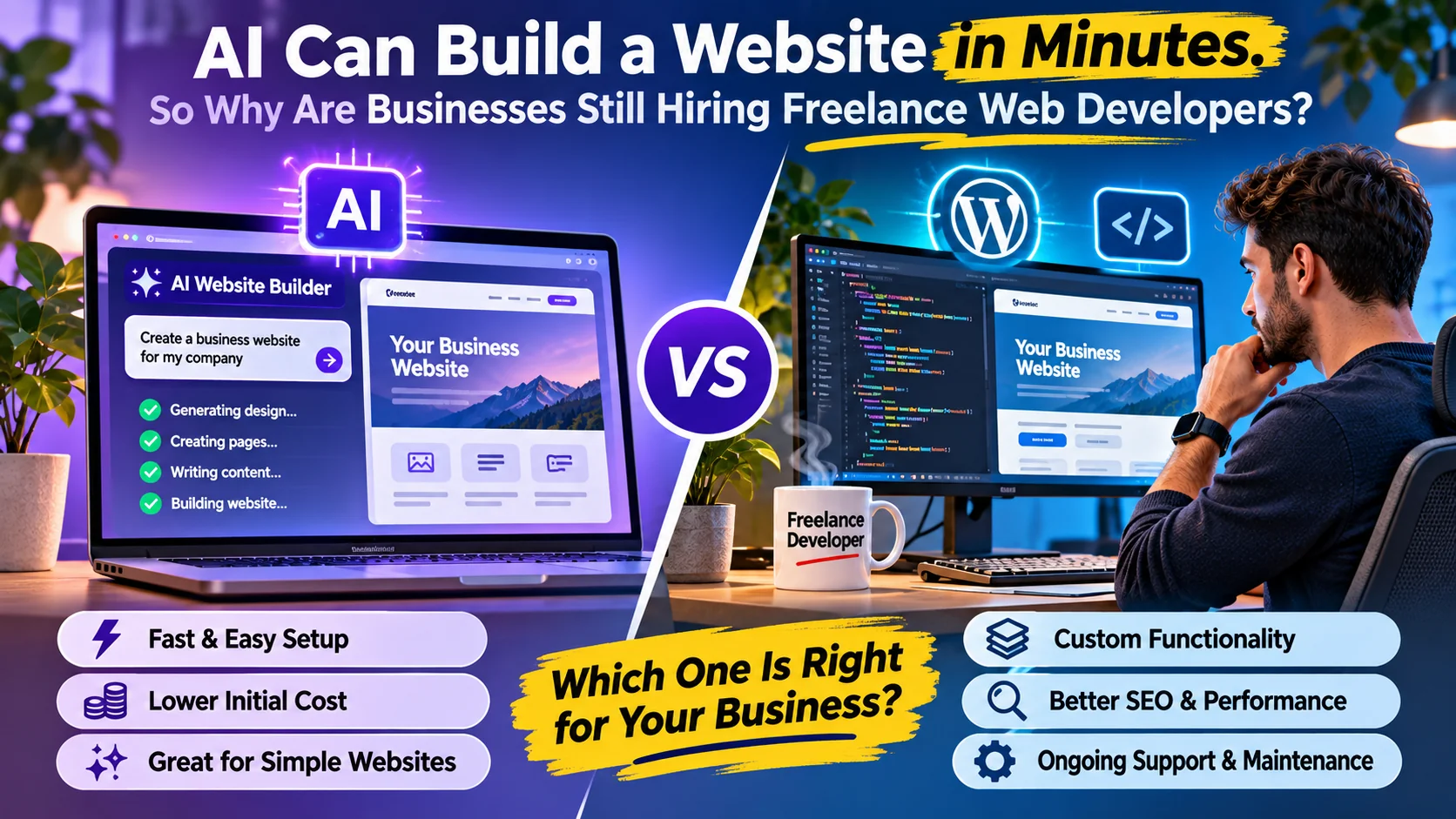
Imagine opening your laptop, typing a short description of your business, and watching an AI tool generate an entire website.
No coding. No complicated installation process. No waiting for someone to design the first page.
A few minutes later, you have a homepage, service sections, images, navigation, and a contact form.
It sounds like the end of traditional website development.
So why are businesses still paying freelance web developers?
Because creating a website and building a website that reliably supports a business are not always the same thing.
AI website builders are useful. They can save time, lower the barrier to entry, and help small companies establish an online presence.
But the decision becomes more complicated when a website needs custom functionality, reliable integrations, strong search visibility, or ongoing technical responsibility.
As a freelance web developer, I don't believe businesses should automatically hire a professional for every website.
Sometimes an AI website builder is the right choice.
Other times, hiring an experienced developer can prevent expensive technical mistakes and provide capabilities that a do-it-yourself setup does not easily deliver.
Here's how to decide.
AI Website Builders Are Getting Better — Much Better
The discussion about AI replacing web developers is no longer hypothetical.
Website platforms have introduced tools that can generate and refine layouts, content, and functionality using natural-language instructions.
In January 2026, Wix announced Wix Harmony, a website-building experience combining AI-assisted creation with visual editing.
Squarespace also offers Blueprint AI, which helps businesses generate website structures and design directions.
These tools can reduce the amount of manual work needed to get an initial website online.
For a freelancer, startup, restaurant, or small local service company that needs a simple online presence, this is a meaningful improvement.
However, a generated website is still a starting point.
Someone must confirm that its information is accurate, that customer inquiries reach the correct person, that the website works across devices, and that the finished experience supports the company's goals.
Generating pages is only one part of creating a useful business website.
The Real Question Isn't Whether AI Can Build a Website
AI can already produce functional websites.
The more useful question is:
Can the website handle everything your business needs, today and as it grows?
Consider two different companies.
The first is a local photographer who needs a portfolio, contact form, and information about available services.
An AI website builder may be entirely sufficient.
The second is a construction company with multiple service areas, a substantial existing website, lead-generation campaigns, tracking requirements, and custom customer inquiry workflows.
That business may need more than generated pages.
It may require a developer to preserve existing search visibility, configure reliable tracking, build integrations, and maintain the website as business requirements change.
Both companies need a website.
But they do not necessarily need the same development process.
1. AI Can Generate a Design. A Developer Can Help Solve a Business Problem
Imagine you own a roofing company.
You tell an AI website builder:
"Create a professional roofing website with a modern design, service pages, and a contact form."
The tool produces a visually attractive website.
It has a hero section, roofing images, testimonials, a service overview, and a contact button.
That is useful.
But what happens next?
Will a visitor immediately understand whether the company serves their location?
Can someone looking for emergency roof repair find the relevant service?
Does the contact form correctly capture phone numbers and project details?
Are calls and form submissions measured properly?
Can the business update its service areas without creating confusing duplicate pages?
These questions require understanding how the company operates and what its customers need.
AI can assist with many of these tasks, but an effective website still requires informed decisions and verification.
A freelance web developer can be responsible for translating business requirements into specific functionality, then testing whether it works.
That distinction matters.
A beautiful homepage is not automatically an effective lead-generation system.
2. A Cheap AI Website Isn't Always the Cheapest Long-Term Option
Cost is one of the main reasons businesses consider AI website builders.
Some platforms offer free entry-level options, while paid plans may combine hosting, website editing, and business features.
For a straightforward website, this can be an economical solution.
But comparing prices requires looking beyond the initial subscription or development fee.
Consider the total cost of operating the website.
This may include:
Subscription and hosting charges.
Premium tools and third-party integrations.
Content updates and ongoing administration.
Additional functionality.
Payment or transaction-related charges.
Maintenance and troubleshooting.
Redesigns or migrations when requirements change.
A freelance developer may have a higher initial cost, particularly for a custom project.
That investment can make sense when the work includes functionality, integration, or technical support that would otherwise require substantial additional effort.
However, custom development also creates maintenance responsibilities and does not guarantee lower lifetime costs.
The right comparison is not simply "$20 per month versus $2,000."
It is the cost of achieving and maintaining the specific website your business requires.
3. AI Websites Can Rank on Google — But AI Doesn't Guarantee SEO
One misconception is that AI-generated websites cannot rank on Google.
That is not correct.
Google's guidance on generative AI content focuses on usefulness, accuracy, originality, and compliance with its search policies.
Using AI does not automatically prevent a website from appearing in search results.
But neither does using AI provide an automatic ranking advantage.
A business website still needs to satisfy relevant search intent.
For example, a local plumbing company may need well-structured service pages, accurate business information, useful content, clear navigation, and a technically accessible website.
It also needs a reason for customers to choose its services.
AI-generated text may describe plumbing services generally while failing to explain the company's actual specialties, working process, or service coverage.
Publishing that content without reviewing it can leave a website looking polished but unconvincing.
A developer with technical SEO experience can help evaluate:
Crawlability: Can search engines access the important pages?
Indexing: Are the correct URLs eligible for indexing?
Website structure: Are services and related pages organized logically?
Performance: Does the website load and respond well on actual devices?
Technical implementation: Are redirects, canonical URLs, structured data, and other technical elements implemented where appropriate?
These are practical tasks, not guarantees of rankings.
A website built by a freelancer can still perform poorly in search if these fundamentals are neglected.
The technology used to build a site matters less than the quality of the finished implementation.
4. Custom Functionality Changes the Conversation
Suppose a business needs more than a standard website.
It requires customers to upload documents, submit custom requests, access private information, or interact with an internal business system.
An AI website builder might support some of these features directly or through integrations.
Modern visual platforms are increasingly capable.
But as requirements become more specific, businesses must consider flexibility, data handling, integration limits, and maintenance.
For example, a company might need its website to communicate with a custom customer relationship management system.
Another business may need custom WooCommerce checkout rules or specialized inventory synchronization.
A third might need a React or Next.js application with a tailored interface.
These requirements may justify hiring a developer who can design, implement, and test the solution.
Not because AI cannot write code.
But because someone needs to ensure the implementation is correct, secure, maintainable, and appropriate for the business.
5. Who Fixes the Website When Something Goes Wrong?
This question is often overlooked.
A website can work during launch and encounter problems later.
An integration can stop sending data.
A contact form may no longer deliver submissions.
A plugin update can cause a conflict.
A third-party API can change.
A checkout process may fail for a particular payment method.
With a hosted AI website builder, the platform may handle much of the infrastructure and provide product support.
That is a genuine advantage.
However, platform support may not include diagnosing every custom business workflow or interpreting why a specific integration no longer performs as expected.
With a freelance developer, businesses can agree on responsibility for testing, troubleshooting, and ongoing improvements.
That responsibility must be defined clearly in the contract.
Hiring a developer does not automatically provide around-the-clock support or unlimited maintenance.
But a properly structured working relationship can give a business a designated technical contact who understands its implementation.
For organizations relying on websites for customer inquiries or transactions, that continuity can be valuable.
6. What About Website Ownership and Portability?
Before committing to any website platform, businesses should ask what happens if they want to leave.
Can website content be exported?
Can the design be transferred?
Are there restrictions on moving the website to another hosting provider?
What happens to forms, customer data, integrations, and subscriptions?
Different website builders have different export and portability capabilities.
WordPress generally provides considerable flexibility in hosting and customization, although specific themes, plugins, and services may introduce dependencies.
Custom development can offer more control over implementation, but only if ownership, source-code access, licenses, and documentation are properly established.
A developer should explain these considerations before a business commits to a long-term technical direction.
The most expensive website migration is sometimes the one a company never planned for.
7. AI Is Also Changing How Freelance Web Developers Work
The discussion is frequently framed as a competition:
AI versus developers.
But that framing ignores an important possibility.
Freelance developers can use AI as part of their work.
AI-assisted tools may help draft code, explain unfamiliar APIs, generate initial layouts, create documentation, or accelerate repetitive tasks.
A developer can use that assistance while still reviewing the result, testing edge cases, and making technical decisions.
For clients, the relevant question is not whether the freelancer uses AI.
It is whether the delivered work meets the agreed requirements.
A developer who uses AI responsibly may reduce unnecessary manual work.
However, generated code can contain errors, security problems, inappropriate assumptions, or unnecessary complexity.
It should not be deployed simply because it looks correct.
Ultimately, businesses benefit from effective processes and verified results, not from insisting that every line of code be written manually.
8. When You Should Use an AI Website Builder
An AI website builder may be the right choice when your requirements are relatively simple.
For example, you may need a basic personal portfolio, a temporary campaign page, an informational website, or an early-stage business presence.
It is especially attractive when you are comfortable reviewing the generated content, configuring the platform, and handling routine changes yourself.
The main advantages are convenience, speed, and a lower barrier to launching.
Before publishing, review the generated content carefully.
Check that every business claim is accurate, every contact method works, and the website looks appropriate on mobile devices.
Also understand the platform's pricing, features, data policies, and export options.
For a small project, these steps may be enough.
You do not need to hire a freelance developer simply because professional development exists.
9. When Hiring a Freelance Web Developer Makes More Sense
Hiring a developer becomes more attractive when the website is technically complex, commercially important, or difficult for the business to maintain internally.
Examples include:
A growing eCommerce store: Payment flows, inventory management, integrations, and order data require careful handling.
An established business redesign: Existing URLs, content, tracking, and search visibility should be considered before major changes.
Custom integrations: Your website needs to communicate with external software or internal business systems.
Complex WordPress requirements: You need custom functionality, technical troubleshooting, or tailored WooCommerce development.
Ongoing technical support: Your business needs someone to maintain, improve, and troubleshoot the website over time.
Performance and conversion improvements: The existing website needs a structured technical review rather than a completely new design.
In these situations, the value of a freelancer comes from judgment, implementation, communication, and responsibility.
Not simply the ability to produce code.
10. AI Website Builder vs Freelance Developer: Five Questions Before You Decide
Before choosing either option, ask yourself five questions.
First: What must my website actually do?
Write down the essential functionality, not just the appearance you want.
Second: What happens if the website stops working?
If downtime or broken forms would significantly affect business operations, plan your support and recovery arrangements carefully.
Third: Who will maintain the website?
A website needs ongoing attention, regardless of how it was created.
Fourth: Will the business need custom functionality later?
Consider your likely needs over the next year or two and whether your platform can accommodate them.
Fifth: Can I evaluate the finished result myself?
If you cannot comfortably assess functionality, accessibility, technical SEO, and integrations, professional assistance may be worthwhile even when AI handles much of the initial creation.
These questions are more useful than assuming that AI is always cheaper or professional development is always better.
The Future of Freelance Web Development Isn't Just Writing Code
AI is changing the economics of website creation.
Basic layouts, repetitive coding tasks, and initial content drafts can increasingly be automated.
That means the value of freelance developers cannot depend entirely on producing ordinary website pages.
The skills that matter increasingly include understanding business requirements, integrating systems, resolving technical problems, evaluating risks, and maintaining complex applications.
Developers also need to communicate clearly about what they can accomplish and which approaches provide the most value.
For business owners, this shift can be positive.
It creates more ways to build websites and gives companies greater flexibility in choosing how much professional support they require.
The right approach might be an AI website builder.
It might be a custom website developed by a freelancer.
Or it might combine AI-assisted development with professional review and implementation.
My Perspective as an Independent Freelance Web Developer
I'm Amarildo Prendi, a freelance web developer based in Albania, working remotely with businesses and agencies internationally.
My work includes WordPress, WooCommerce, custom website development, React, JavaScript, PHP, technical SEO, and website performance.
I don't believe every business needs a custom-coded website.
If a simple website builder can satisfy your requirements reliably and economically, it may be the most sensible choice.
But when a project involves complex integrations, website migrations, technical troubleshooting, custom development, or ongoing maintenance, professional implementation becomes more important.
My goal as a developer is to understand what the business needs and choose a practical technical approach.
You can review my WordPress development services and website development packages to see the types of work I offer.
Final Verdict: AI Can Build Websites, but Businesses Still Need Technical Judgment
AI website builders are not a temporary trend.
They are useful tools that are changing how websites are created.
For simple projects, they can be an excellent option.
For more demanding websites, professional developers can provide technical planning, tailored implementation, troubleshooting, and ongoing support.
The question should not be whether AI can replace every freelance developer.
It should be whether the chosen approach delivers the website your business actually needs.
AI can help you launch a website faster. The real challenge is making sure that website continues to work for your business.
Need a Freelance Web Developer for Your Business?
If you're deciding between an AI website builder, WordPress, or custom development, I can help review your requirements and determine what makes technical sense.
I work directly with businesses on website development, WordPress improvements, technical SEO, performance, and maintenance.
Explore my portfolio and professional service packages, or contact me through AmarildoPrendi.com to discuss your project.